.png)


Hadzabe vs Maasai Cultural Experiences: What’s the Difference?


Travelers often ask the same question when planning a cultural journey to Tanzania:Should I visit the Hadzabe or the Maasai?
At first glance, both are Indigenous communities in northern Tanzania. But in reality, the cultural experiences they offer could not be more different. They represent two fundamentally distinct ways of being human, shaped by radically different relationships to land, leadership, work, and social life.
This article offers a clear, anthropologically grounded comparison to help you understand which experience aligns with who you are and what kind of encounter you’re truly seeking.
In short: Visiting the Hadzabe and the Maasai offers two very different cultural experiences in Tanzania. The Hadzabe represent a hunter-gatherer way of life based on equality, mobility, and daily subsistence, while the Maasai are pastoralists with a structured social system centered around cattle, ritual, and age sets. This article helps travelers understand which experience suits their interests, time, and way of learning.

Who Are the Hadzabe and the Maasai?
The Hadzabe and the Maasai are among the most well-known Indigenous peoples of Tanzania, yet their cultures are often mistakenly grouped together.
The Hadzabe are one of the last remaining full-time hunter-gatherer societies in the world. They have lived around Lake Eyasi for tens of thousands of years, relying on hunting, foraging, and deep ecological knowledge rather than agriculture or livestock. For a deeper understanding of their way of life, see our detailed guide:The Ultimate Guide to the Hadza (Hadzabe) People of Tanzania: Culture, Hunting, Honey, Diet and Daily Life.
The Maasai, by contrast, are semi-nomadic pastoralists whose identity centers around cattle, seasonal movement, and a highly structured social system. Their red shúkà cloth, beadwork, and age-set rituals are iconic, but their cultural depth goes far beyond visual symbolism. We explore this in depth in:Maasai Culture in Tanzania: Traditions, Rituals, Beliefs & Daily Life of the Maasai Tribe.
Understanding the difference between these two societies is essential before choosing which experience is right for you.

The Hadzabe Hunter-Gatherers vs Maasai Pastoralists: Two Completely Different Ways of Life
The most fundamental difference between the Hadzabe and the Maasai lies in how these communities relate to food, land, and time.
The Hadzabe way of life closely resembles that of our earliest human ancestors, the first hunter-gatherer societies that originated in Africa. In hunter-gatherer societies, life is generally flexible and egalitarian. There are no chiefs, no rigid hierarchies, and no formal systems of power. Because survival does not depend on surplus or accumulation, there is little incentive to control resources or rule over others. Anthropological studies have shown that this lack of stored wealth reduces conflict and the need for authority.
Men and women among the Hadzabe have distinct roles, but they are broadly equal in status and decision-making. Both contribute essential skills to daily survival, and neither gender holds structural dominance over the other. One of the clearest examples of this shared subsistence is honey hunting, a practice that combines ecological knowledge, cooperation, and deep relationships with the environment, explored further in The Hadzabe Honey Hunters of Tanzania: Wild Honey, Culture, Diet & Honeyguide Bird Explained.
The Maasai, by contrast, are a patriarchal and patrilineal society with a clearly defined social hierarchy. Authority traditionally rests with men, particularly elders, and lineage is traced through the male line. For the Maasai, cattle and children represent the greatest form of wealth and social security a man can possess. Polygyny, the practice of marrying multiple wives, is part of this patriarchal system and is closely tied to cattle ownership and social status.
Ritual life plays a central role in maintaining Maasai social structure. Age-set ceremonies mark transitions in responsibility, authority, and identity, reinforcing communal bonds and generational continuity. One of the most significant of these rites is the Eunoto ceremony, which marks the passage into elderhood and is described in depth in Unveiling the Maasai Traditions: An Eunoto Cultural Rite of Passage in Tanzania.
The Hadzabe live very much day to day. Food is gathered or hunted as needed and shared immediately within the group. There is no food storage, no accumulation, and no concept of wealth as something to be built over time. Mobility is fluid, and decisions are made collectively, often through quiet consensus rather than instruction.
The Maasai way of life revolves around livestock. Cattle represent wealth, sustenance, and spiritual value combined. Daily life follows seasonal rhythms, grazing patterns, and long-established social responsibilities tied to age, gender, and lineage.
These differences are not merely economic. They shape everything from child-rearing and gender relations to conflict resolution and how visitors are perceived and integrated into daily life.

Daily Life with the Hadzabe vs the Maasai
Spending time with the Hadzabe means entering an unscripted daily rhythm. There is no schedule and no performance, only daily life as it unfolds.
Mornings with the Hadzabe are dedicated to hunting. You wake before sunrise and head out with the men, moving quietly through the savanna as the landscape comes alive in the early light. Hunting may last a short time or continue for hours, depending on what is encountered. If larger game such as a baboon is spotted, the hunt can extend well into the day, while smaller game like birds or rodents may bring an earlier return. You can learn more about the techniques, tools, and timing of these early hunts in our detailed Hadzabe hunting guide.
After returning to camp, meals are shared, often as a late breakfast or brunch depending on how long the hunt lasted. There is no fixed mealtime, only collective adjustment to the day’s events.
Afternoons are spent gathering with the women. You forage for tubers and wild berries, learning how food is identified, dug, prepared, and shared. In total, the Hadzabe spend only around four hours per day collecting food, far less than many people assume. Survival is not a full-day task.
The remaining hours are spent in camp. Tools are repaired, arrows shaped, and daily objects maintained. People rest, talk, laugh, and play. During the strongest midday heat, everyone stays in the shade, as movement is unnecessary and the sun is too intense.
With the Maasai, daily life follows a more structured rhythm shaped by pastoral responsibilities and social roles.
Mornings typically begin with milking cows and goats, a task carried out by women. After milking, families gather inside the house to prepare tea, and visitors are often invited to join. Breakfast is shared, and the day’s activities are discussed.
Afterward, roles are clearly defined. Visitors may accompany herders with livestock, observe beadwork, or take part in community gatherings. Cultural explanations are more verbalized and intentional, and over time you may spend extended periods either with women or with men, gaining insight into both spheres of Maasai life. Many first-time visitors are surprised by how different daily reality is from popular stereotypes, which we explore further in Who Are the Maasai? The 4 Most Common Myths About Maasai Culture.
Neither experience is more authentic than the other. Both are authentic in different ways. Because life is not staged, there are also moments when nothing happens. These quieter periods are an essential part of real life. Time is spent resting, listening, observing, and simply being present.

Rituals, Beliefs, and Worldview
Hadzabe spirituality is deeply embedded in daily life rather than formal ceremony. Beliefs are tied to the land, animals, and unseen forces, but they are rarely articulated as doctrine. Meaning is lived rather than explained.
The Hadzabe do not have a centralized religion, priests, or ritual calendar. Their spiritual worldview is animistic and relational, shaped by constant interaction with the environment. They believe in a creator figure often referred to as Haine or Ishoko, associated with the sky and natural forces, but this deity is not worshipped through prayer, temples, or offerings. Instead, spiritual understanding is expressed through everyday actions, storytelling, respect for animals, and the way people move through the landscape.
Ceremonial life among the Hadzabe is minimal and situational rather than formalized. The most notable ritual practices include trance dances and healing dances, which may be performed when illness, imbalance, or misfortune affects the group. These dances involve singing, rhythm, and altered states of consciousness, but they are not scheduled events and visitors may or may not witness them. Spiritual life is fluid, personal, and inseparable from daily subsistence.
Maasai spiritual life, by contrast, is structured, ceremonial, and explicitly articulated. The Maasai are monotheistic and believe in a single god, Enkai (also known as Engai), who embodies both benevolent and destructive aspects of life. Enkai is closely associated with rain, fertility, cattle, and balance, and is seen as the ultimate source of life and order. Unlike many animistic belief systems, the Maasai do not worship nature spirits or multiple deities. Their relationship with Enkai is mediated through prayer, ritual, and moral conduct rather than through the natural world itself.
Rituals play a central role in maintaining Maasai social continuity. Their society is organized around an age-set system common across much of East Africa, in which individuals move through clearly defined life stages together as a group. Major rites of passage include initiation ceremonies marking the transition from childhood to warriorhood, and later from warriorhood to elder status. These ceremonies often involve communal gatherings, blessings, feasting, and symbolic acts that reinforce responsibility, authority, and social cohesion. Symbolism is also expressed visually, especially through beadwork, where colors carry specific meanings related to age, status, and life stages, explored in more detail in What Do the Colors of Maasai Beads Mean? Explore the Traditions of Color Symbolism.
For visitors, this results in very different ways of encountering belief. With the Hadzabe, spirituality is observed quietly through daily life, relationships, and moments that may pass without explanation. With the Maasai, belief is more visible and interpretable, expressed through spoken teachings, ritual participation, and clearly marked ceremonial events. Both offer profound insight, but through entirely different modes of presence and understanding.
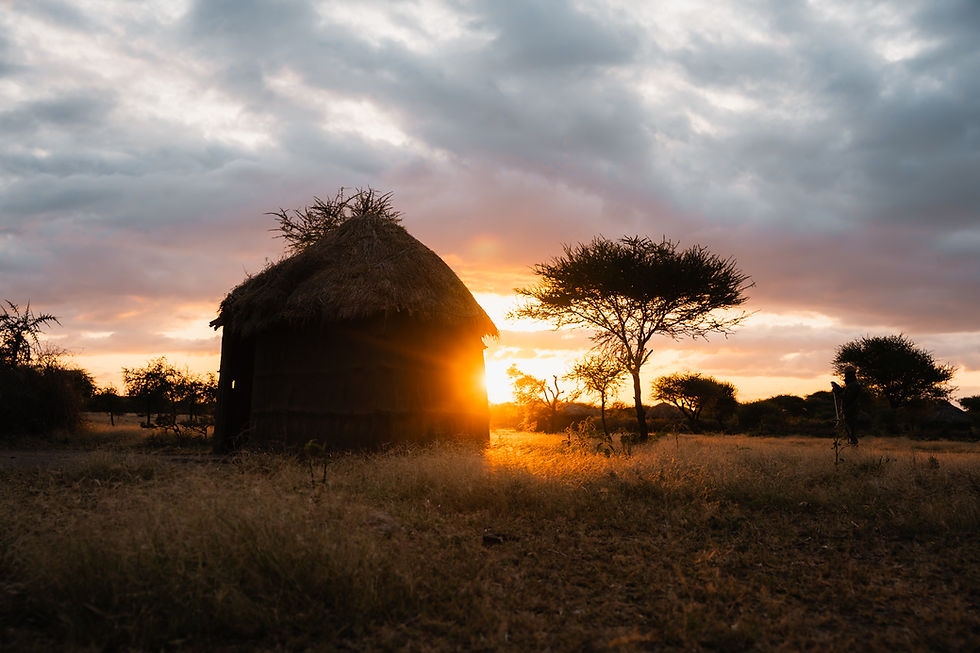
Bush vs Savanna
The landscapes in which the Hadzabe and the Maasai live are not just backdrops to culture. They actively shape how life is organized, how people move, and how belief systems develop.The Hadzabe live in and around Lake Eyasi, within the Great Rift Valley.
This environment is rugged, dry, and ecologically diverse, made up of bushland, rocky outcrops, seasonal water sources, and open savanna. Towering baobab trees dominate the landscape, serving as important ecological markers and gathering points, and giving the area its distinctive, timeless character. Survival here depends on intimate knowledge of the land. Every plant, track, and animal sign carries meaning. The landscape is not owned, fenced, or divided. It is read, remembered, and shared, a relationship shaped by place as much as by movement, as explored in more detail in Hadzabe Tribe Location: Where Do They Live in Tanzania?.
Because the Hadzabe move frequently and leave little permanent trace, their relationship to the land is lightweight and flexible. Camps shift with seasons, water availability, and game movement. The land is not something to be controlled but something to move within.
The Maasai traditionally inhabit wide open savanna regions of northern Tanzania and southern Kenya. These grasslands are well suited to pastoralism, allowing cattle to graze across large territories. The landscape supports seasonal movement rather than constant mobility, with grazing routes, homesteads, and water points forming a known and managed system.
For the Maasai, land is closely tied to cattle, lineage, and continuity. Grazing areas are remembered, negotiated, and defended when necessary. While movement is still central to Maasai life, it follows established patterns shaped by climate, social agreements, and generational knowledge.
For visitors, these landscapes create very different embodied experiences. Time with the Hadzabe often involves walking long distances, tracking subtle signs, and spending hours in quiet observation. With the Maasai, the landscape is experienced through herding, settlement life, and communal spaces where people gather, work, and ritual life unfolds.
In both cases, the land is not scenery. It is an active participant in daily life, shaping culture in ways that cannot be separated from the people themselves.

Which Cultural Experience Is Right for You?
Choosing between the Hadzabe and the Maasai is not about which culture is better. It is about which way of being human you are ready to encounter.
If you are drawn to anthropology, human origins, and observing life without hierarchy or accumulation, the Hadzabe experience may resonate more deeply. Time with the Hadzabe is quiet, immersive, and often unpredictable. You are not guided through explanations but invited to observe, participate, and adapt. Comfort is minimal, structure is loose, and much of what you learn comes from presence rather than conversation. This way of life is closely tied to food sharing, mobility, and a diet shaped entirely by the land, explored further in 5 Eye-Opening Facts About the Hadza Diet And What Hunter-Gatherers Can Teach Us. This experience suits travelers who are patient, curious, and comfortable with simplicity and silence.
If you are interested in social systems, ritual life, and clearly articulated cultural frameworks, the Maasai experience may be a better fit. Life with the Maasai is more structured and interpretive. Roles are explained, rituals are visible, and daily activities follow recognizable patterns. Visitors often find it easier to contextualize what they are seeing in real time. Daily life also carries clear social values around responsibility, community, and resilience, reflected in lessons many visitors take home, as explored in 4 Life Lessons from Living in a Maasai Village in Tanzania. This experience suits travelers who value dialogue, explanation, and witnessing traditions that are actively maintained.
Your relationship with animals may also influence your choice. Life with the Maasai is closely intertwined with domestic animals. You are surrounded by cows, sheep, goats, and donkeys, and daily activities often include milking, herding, and caring for livestock. Animals are constantly present and central to daily life. With the Hadzabe, domestic animals play almost no role. Aside from a few hunting dogs, daily life unfolds in close relationship with wildlife instead. Time is spent moving through the bush, tracking animals, and reading the signs of the land. Encounters with wild animals are possible, not as spectacles, but as part of everyday survival.
Time is another important factor. If you only have a short amount of time, such as one night from Arusha, a Maasai visit is the more realistic option. Maasai communities are easier to access, and a shorter stay can still offer a meaningful cultural experience. The Hadzabe live much farther away, and reaching them typically takes a full day of travel. Visiting for only one night would mean spending most of your time on the road rather than in the community. To truly experience Hadzabe life, at least two nights are recommended.
Whichever experience you choose, how you approach the visit matters as much as where you go. Taking time to understand consent, expectations, and respectful behavior helps ensure that cultural encounters are meaningful for both visitors and hosts. We explore this in depth in How to Visit Indigenous Communities Respectfully: The Complete Guide to Ethical Indigenous Tourism.
Practical preparation also plays a role in how smoothly the experience unfolds. Knowing what to pack, how to prepare for basic conditions, and what daily life in the bush actually involves can make a significant difference, especially for first-time visitors. A detailed overview is available in Traveling to the Bush in Tanzania: What to Pack and How to Prepare for a Maasai & Hadzabe Homestay.
For those with the time and openness, visiting both communities offers the most complete perspective. Together, the Hadzabe and the Maasai reflect two major stages of human history. All humans were once hunter-gatherers, living as the Hadzabe still do today. Later, humans learned to herd animals and practice pastoralism, a way of life embodied by the Maasai. Experiencing both offers a rare and powerful insight into the deep history of humankind and the many ways humans have learned to live with land, animals, and one another.
In the end, the right cultural experience is not the one that feels most comfortable, but the one that expands how you understand humanity itself.
Interested in Experiencing This in Real Life?
If reading this helped clarify which cultural experience might suit you, Visit Natives works directly with Hadzabe and Maasai hosts to facilitate small-scale, Indigenous-led stays. Some readers choose to continue reading.Others prefer to explore what these experiences look like in practice.
You can explore available Maasai and Hadzabe journeys through Visit Natives. |

Daily Activities Compared
🐄 Maasai Activities | 🏹 Hadzabe Activities |
Milking cows and goats | Hunting with bows and arrows |
Herding cattle across the savanna | Tracking animals in the bush |
Caring for livestock daily | Gathering tubers and bush berries |
Jewelry and beadwork making | Honey collecting (seasonal) |
Singing and rhythmic chanting | Tool making and repairing arrows |
Traditional dancing during gatherings and ceremonies | Campfires every night |
Maasai activities revolve around livestock and social structure.
Hadzabe activities revolve around subsistence, movement, and daily cooperation with nature.

Frequently Asked Questions: Hadzabe vs Maasai
What is the main difference between the Hadzabe and the Maasai?
The main difference is their way of life. The Hadzabe are hunter-gatherers who rely on hunting, foraging, and deep ecological knowledge, while the Maasai are pastoralists whose lives revolve around livestock, especially cattle. These two cultures represent very different relationships to land, food, leadership, and time.
Which is better to visit, the Hadzabe or the Maasai?
Neither is better. They offer fundamentally different experiences. The Hadzabe experience is quiet, immersive, and observational, while the Maasai experience is more structured, social, and interpretive. The right choice depends on your interests, time available, and how you prefer to learn.
How many days do I need to visit the Hadzabe?
At least two nights are recommended. The Hadzabe live in the Lake Eyasi area, far from major towns. The nearest town is Karatu, located about one hour from the Ngorongoro Conservation Area gate. From Arusha, it takes roughly four hours to reach the Hadzabe camps in the deep bush. Visiting for only one night would mean spending most of your time traveling rather than actually living alongside the community.
Can I visit the Maasai if I only have one night?
Yes. Maasai communities are much easier to access, especially from Arusha, and even a one-night visit can provide a meaningful cultural experience. Depending on the location, it is possible to reach an authentic Maasai boma within approximately more or less two hours from Arusha.
What activities can visitors do with the Hadzabe?
Visitors may join morning hunts, track animals, gather tubers and bush berries, practice archery, help with tool making, sit around evening campfires, and participate in singing and dancing. Activities are not scheduled and depend on daily life and conditions.
What activities can visitors do with the Maasai?
Visitors often participate in milking cows, herding livestock, jewelry and beadwork making, singing, dancing, and community gatherings. Daily activities are more structured, and cultural explanations are usually shared verbally.
Are the Hadzabe and Maasai experiences staged for tourists?
Some cultural visits can be staged or performative. However, all experiences offered by Visit Natives are based on real daily life and are led by Indigenous hosts themselves. This also means there are moments when nothing happens. Resting, waiting, observing, and sharing quiet time are part of everyday life, and therefore part of the experience.
Do the Hadzabe and Maasai have the same beliefs?
No. The Hadzabe have an animistic worldview with a creator figure associated with the sky, but no formal religion or ritual calendar. The Maasai are monotheistic and believe in one god, Enkai, with ritual life organized around age-set ceremonies and social transitions.
Is it ethical to visit Indigenous communities like the Hadzabe and Maasai?
Yes, when done responsibly. Ethical visits require consent, fair compensation, cultural respect, and realistic expectations. How visitors behave and prepare matters as much as where they go, which is why we recommend reading How to Visit Indigenous Communities Respectfully: The Complete Guide to Ethical Indigenous Tourism before visiting any Indigenous community.
Experience the Hadzabe and the Maasai With Indigenous Hosts If you feel drawn to experiencing either the Hadzabe or the Maasai, Visit Natives offers small-group and private cultural journeys that are led by Indigenous hosts themselves. Our experiences are based on real daily life rather than performances. They are designed in close collaboration with Hadzabe and Maasai communities, with a strong focus on consent, fair compensation, and long-term relationships. Time is spent living alongside people, not observing them from the outside.
Whether you choose a short stay with the Maasai, a deeper immersion with the Hadzabe, or a journey that includes both, each experience is shaped by respect, presence, and cultural integrity. You can explore available journeys and request a booking through Visit Natives’ authentic Maasai and Hadzabe experiences. |

About the Author
This article is written by Anniina Sandberg, an anthropologist and the founder of Visit Natives, a boutique travel company focused on Indigenous-led and community-based cultural experiences.
Anniina holds a Master’s degree in African Studies and has spent years living, researching, and working alongside Indigenous communities in Tanzania and beyond. Her work is grounded in long-term relationships with Hadzabe hunter-gatherers, Maasai pastoralists, and other Indigenous groups, with a strong focus on ethical engagement, consent, and cultural integrity.
Rather than approaching cultures as tourist attractions, her perspective is shaped by anthropological fieldwork, lived experience, and collaboration with Indigenous hosts themselves. Through Visit Natives, she designs journeys that are based on real daily life rather than staged performances, ensuring that communities remain in control of how their culture is shared.
Anniina writes about Indigenous cultures, human origins, and responsible travel with the aim of helping readers understand not just where to go, but how to engage with humility, curiosity, and respect.


