.png)


Women in Hunter Gatherer Societies: Gender Roles, Equality and Independence Among the Hadzabe

Updated: Jul 8

Quick Answer
Hadzabe women in Tanzania have a level of equality and independence that challenges the common idea that women in hunter gatherer societies were naturally dependent on men. In Hadzabe society, women and men have different roles, but different roles do not automatically mean unequal status.
Hadzabe women gather much of the reliable daily food, hold essential ecological knowledge and are not economically dependent on a single male provider. They can choose partners, leave relationships and move between camps, which gives them real autonomy over their lives.
This does not mean that Hadzabe society is perfect or that all hunter gatherer societies are the same. But it does challenge the assumption that women’s dependence on men and strict male dominance are timeless or inevitable parts of human society. As a female cultural anthropologist and Africa researcher, I have spent time with hunter gatherer communities in Tanzania. One of the things that has surprised me most is how familiar the lives of women can sometimes feel.
|
I remember one evening sitting by the fire with a Hadzabe woman in Tanzania and realising that, although we came from completely different worlds, we shared some of the same fundamental freedoms.
I am a Nordic woman. She is a Hadzabe woman living in a hunter gatherer society. Our homes, daily lives and ways of surviving could hardly be more different. Yet we both have the freedom to choose our partners. We can leave relationships that do not work. We can contribute to our own survival and freedom. Neither of us is expected to belong to a man simply because we are women.
That moment made me think differently about the way we tell the story of women in human history. For most of human history, people lived as hunter gatherers. Agriculture began only around 12,000 years ago, which means that for the vast majority of our existence as Homo sapiens, humans survived by hunting, gathering, sharing food and moving through the landscape.
Yet when we imagine this long period of human history, we still tend to see it through a familiar old picture: men went out to hunt while women stayed behind with the children, dependent on what the men brought back.
Anthropology tells a far more complex story.
Among the Hadzabe, women and men traditionally have different roles, but different does not mean unequal. Hadzabe women contribute directly to subsistence, possess knowledge essential to survival and have a remarkable degree of autonomy and independence.
This does not mean that Hadzabe women do not need men, or that men do not need women. Hunter gatherer life is built on cooperation and interdependence. The important distinction is that depending on a community is not the same as women being individually dependent on male providers.
So what do we actually know about women among the Hadzabe? Are they equal to men? What roles do they have? Do Hadzabe women hunt? Can they choose their partners and leave relationships? And what can their lives tell us about women in hunter gatherer societies more broadly, and about what changed when humans began to settle, farm and accumulate property?
If you are new to the Hadzabe, you may first want to read my Ultimate Guide to the Hadza (Hadzabe) People of Tanzania, which gives a broader overview of their culture, hunting, honey, diet and daily life around Lake Eyasi.

Are Hadzabe Women Equal?
Among the Hadzabe, women have a level of equality and independence that may feel surprisingly familiar to women in modern Nordic societies. One important reason is simple: Hadzabe women are not dependent on one individual man to feed them.
Among the Hadzabe, men traditionally hunt while women gather foods such as tubers, berries and baobab. Hunting can be unpredictable. Men may return with a large animal that feeds the whole camp, but they can also spend hours or even days hunting and return empty handed. The foods gathered by women are more reliable. Hadzabe women know where to find food and can provide for themselves and their children even when the hunters bring nothing back.
This does not mean that Hadzabe women do not need men, or that men do not need women. Everyone depends on others. Meat and honey brought by men are highly valued, just as the foods gathered by women are essential to daily life. The point is that a woman’s survival is not tied to one individual man bringing home food.
Marriage does not necessarily create that dependence either. Hadzabe women can choose their partners, and marriage does not tie a woman permanently to one man, one household or one place. If a relationship ends, she does not lose her ability to feed herself or her place within the wider community.
The same freedom can be seen in where people live. Hadzabe people live in small, flexible camps, but they are not permanently tied to one group. Women and men can choose where and with whom they want to live, move to another camp, stay with relatives or simply join people whose company they prefer. If conflicts arise or relationships become strained, one solution is often simply to leave and live elsewhere.
This freedom to move is important to understanding equality among the Hadzabe. When there is no fixed authority forcing people to remain in one place, and when people are free to change camps and social groups, it becomes much harder for one individual to control another. This matters because dependence creates power.
When one person controls the land, the wealth, the home or the food another person needs to survive, it becomes much harder to leave. But when a woman can obtain food herself, choose her partner, leave a relationship, move freely and choose where and with whom she lives, one man has far less power to control her survival.
This is one of the reasons the Hadzabe, like many hunter gatherer societies, have been described as relatively egalitarian. Women and men do not necessarily do the same things, but different gender roles do not automatically mean unequal status. Hadzabe women are not simply waiting for men to provide for them. Men depend on the foods gathered by women just as women share in the foods brought back by men. The relationship is based on interdependence, not one sided dependence.
Why Are Hadzabe Women More Independent?
To understand the independence of Hadzabe women, we need to look beyond gender roles and ask a more fundamental question: what does anyone in Hadza society actually have the power to control?
Among the Hadzabe, there is little accumulated wealth, no private ownership of land and no permanent home controlled by one person. There are no chiefs or formal leaders. Food is shared, people can move between camps and survival depends on a wider social network rather than a single household. This creates a very different foundation for relationships.
A man cannot easily control a woman by threatening to take away the land, the house or her only source of food, because these forms of private wealth do not exist in the same way. If a relationship no longer works, leaving does not necessarily mean losing everything.
We can see the importance of this same basic principle in the history of modern Western societies. For generations, many women remained in marriages partly because leaving could mean losing their home, financial security or the ability to support their children. As women gained greater access to paid work and their own income, reliable contraception, childcare and the legal right to divorce, they gained something equally important: more realistic choices about their own lives.
Research on women’s employment and divorce has found that women’s employment does not make happy marriages more likely to end, but can make it more possible for women to leave marriages that are already unhappy. When a woman can earn her own money, control whether and when she has children, access childcare and legally end a marriage, staying with a husband is less likely to be her only realistic means of survival.
Economic independence changes what choices are realistically available. Hadzabe women did not need to wait for the modern women’s rights movement to gain this kind of independence. In traditional Hadza society, a woman’s survival was not built around dependence on a single male breadwinner in the first place. A Hadzabe woman can obtain food, choose her partner, leave a relationship, move between camps and choose where and with whom she wants to live.
This freedom to move is central to understanding equality among the Hadzabe. Hadzabe camps are small and flexible, and people are not permanently tied to one group. If a relationship ends, a conflict arises or someone simply prefers to live elsewhere, they can move and join another camp. Women do not lose their ability to feed themselves or their place in the wider community simply because they leave a partner or change where they live.
Anthropologists sometimes describe a similar principle as the power of exit: the ability to walk away from a person, a conflict or even an entire group. Among the Hadzabe, this freedom makes it more difficult for any one individual to control another.
For Hadzabe women, this matters enormously. A woman who can obtain food herself, choose her partner, leave a relationship and decide where and with whom she lives has more freedom than someone whose survival depends on one man, one household or one piece of land.
This does not mean that Hadzabe women live without hardship, conflict or unequal relationships. Nor does it mean that women do not need men, or men do not need women. Hadza society depends on cooperation, food sharing and interdependence.
But interdependence is not the same as one sided dependence. The independence of Hadzabe women is not simply an idea or a value. It is supported by the way Hadza society itself is organised.
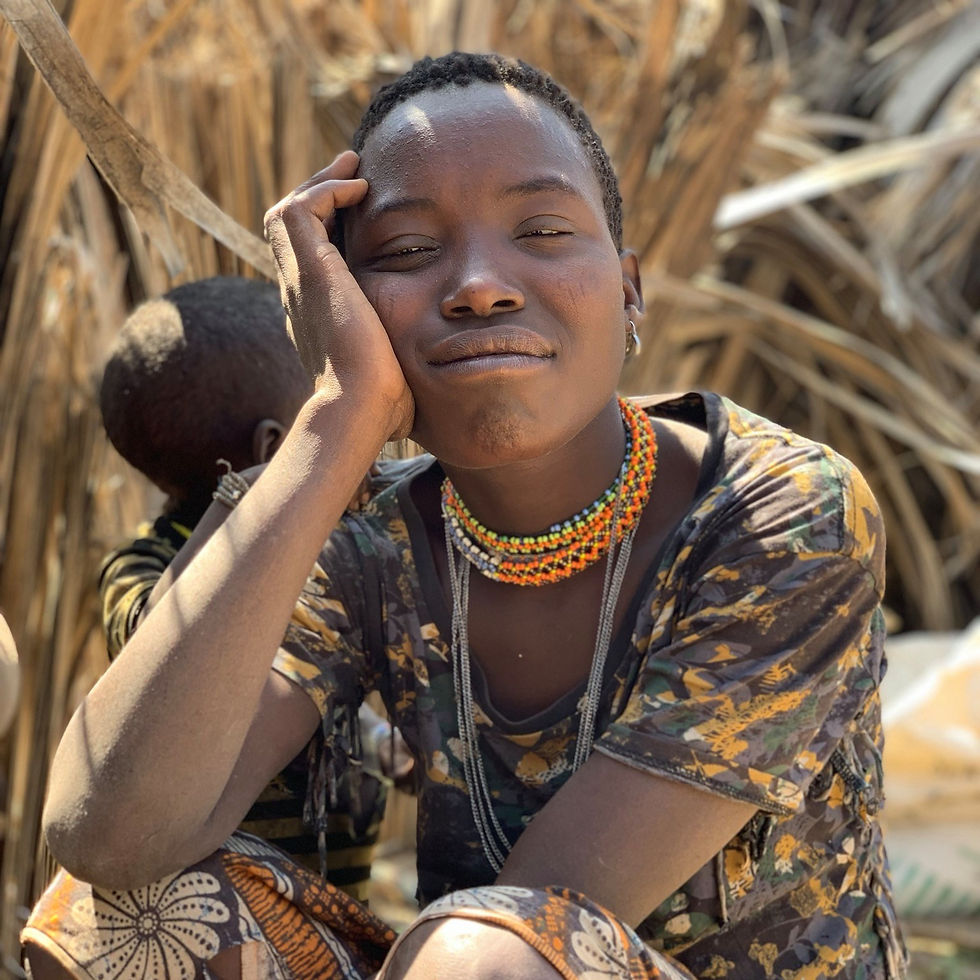
What Is the Role of Hadzabe Women?
Among the Hadzabe, women’s daily lives are active, social and closely connected to the landscape around them. Hadzabe women gather much of the reliable food that comes into camp, care for children, share knowledge and spend a large part of their time with other women.
Hadzabe women also tend to have fewer children than women in many traditional farming populations. This difference has often been linked to the realities of a mobile hunter gatherer way of life, including longer periods of breastfeeding and wider spacing between births. Demographic research has long associated the transition from mobile foraging to more settled agricultural life with an increase in fertility.
The Hadzabe are also an important reminder that hunter gatherer societies are not all the same. Demographic research has estimated a total fertility rate of around 6.1 births per woman among the Hadza, which is relatively high for a hunter gatherer population. Still, the reality is far from the popular image of women in traditional societies constantly surrounded by enormous numbers of children. And having children does not mean that a Hadzabe woman becomes isolated from the rest of society or confined to childcare alone.
Children grow up in the middle of camp life, surrounded by siblings, relatives and other adults. Men also spend time with children in camp, and boys begin joining their fathers and other men in the bush while they are still young. Children learn the skills of Hadza life gradually by watching, following and participating.
Hadzabe women usually go gathering together. Depending on the season, they dig for underground tubers, collect berries and gather baobab fruit. One of the foods they dig from the ground is a wild tuber sometimes described as a bush potato. Tubers are an especially reliable food because they can be found even when hunting is unsuccessful.
Baobab is another important food. Women break open the hard fruit and use the pale pulp inside, which can be mixed with water to make a nutritious food for children. Honey is also one of the most valued foods in Hadzabe life, and its role goes far beyond sweetness. It is food, medicine, trade item and part of a remarkable relationship with the honeyguide bird, which I explore more deeply in The Hadzabe Honey Hunters of Tanzania: Wild Honey, Culture, Diet & Honeyguide Bird Explained.
Hadzabe women return to camp with the food they have gathered, but daily life is not divided into the modern idea of men at work and women isolated at home. Camp is a social space. People sit together, talk, eat, care for children and share what has been brought back.
In the evenings, men and women often gather around their own fires and talk among themselves. Hadzabe women are not expected to perform a separate ideal of female respectability. Women may smoke and drink just as men do, and conversations around the women’s fire can be every bit as lively as those around the men’s.
The gender roles are visible, but they should not automatically be mistaken for a hierarchy. Hadzabe women and men often do different things because those roles work in practice. Women’s gathering is usually done in groups and provides reliable food. Men’s hunting often requires silence, long distances and unpredictable hours. Different work does not necessarily mean different value.
I often think back to one evening when I was sitting around the fire with a group of Hadzabe women. One of the women had three children from a previous relationship and was now with a new partner. At some point during the evening, she called her partner’s name across to the men’s fire nearby. When he came over, she told him that the children needed to go to sleep. He quietly took her three children, who were not biologically his, and went to put them to bed.
The women stayed by the fire. They talked, laughed, smoked and drank alcohol made by the Hadzabe, while I sat with them and listened. Sitting there among the women, I remember thinking how strangely familiar it all felt.
I was a Nordic woman sitting around a fire with Hadzabe women in Tanzania, in one of the world’s last hunter gatherer societies. Our lives could hardly have looked more different. And yet the freedom felt unbelievably familiar. It was girls’ night out by the fire.

Why Is Hadzabe Society More Egalitarian?
The Hadzabe should not be romanticised as perfect, and no hunter gatherer society should be treated as if it had no conflict, hardship or inequality. Many popular ideas about communities such as the Hadzabe are shaped by stereotypes, which is why it is important to separate reality from common misconceptions about the Hadzabe tribe in Tanzania.
Still, Hadzabe society is often described as remarkably egalitarian, and there are practical reasons for this.
A society in which people move frequently leaves little room for accumulating land, property or wealth. Food is shared because no one can store enough to secure power for years to come. There are few permanent positions from which one person can rule over others, and anyone who becomes too controlling risks finding that others simply leave. This matters when we think about the history of Hadzabe women.
We tend to tell women’s history as a long, steady journey towards equality. Women, the story goes, were once dependent on men, and only very recently began to gain freedom through education, paid work, contraception, childcare and legal rights. But for most of human history, humans lived as hunter gatherers.
For hundreds of thousands of years, many human societies were organised in ways that often gave women more autonomy than they would later have in many farming societies, early states and patriarchal systems. Women contributed directly to subsistence and were not automatically tied to a husband through land, property or economic survival.
The major change may not have been that modern societies finally invented equality.
A more uncomfortable possibility is that agriculture, permanent settlement and inherited property changed the conditions in which inequality could grow. Once land could be owned, harvests stored and wealth passed from one generation to the next, family, marriage and reproduction began to carry a different kind of weight. In many parts of the world, women’s lives became more tightly connected to households, inheritance, legitimate children and property controlled by men.
Of course, none of this means that every hunter gatherer society was equal, or that agriculture alone explains the rise of patriarchy. Human societies are never that neat. But it does force us to rethink the usual story. Instead of asking only how women slowly gained rights over time, we should also ask what kinds of freedom women may have had before land, property, inheritance and permanent hierarchies began to reshape human life. Equality may not be something that appeared only at the end of progress. In some ways, it may be something much older.
Experience Life with the Hadzabe in Tanzania
Reading about one of the world’s last hunter gatherer societies is one thing. Spending time with Hadzabe families in the bush is something entirely different.
Visit Natives offers private, immersive journeys with Hadzabe families near Lake Eyasi, where you can learn directly from the people whose culture you have just read about. Walk through the bush, forage for wild food, learn traditional survival skills and spend time in camp as everyday life unfolds around you.
Our experiences are Indigenous led, anthropologist designed and based on long term relationships with the families who choose to host our guests.
|
Frequently Asked Questions About Hadzabe Women
Are Hadzabe Women Equal in Hunter Gatherer Society?
In many mobile hunter gatherer societies, women had considerable autonomy and a more equal position than women in many later agricultural and state societies. This did not mean that women and men always had identical roles, but women often contributed directly to subsistence, had access to wider social networks and were not economically dependent on a single male provider.
Do Hadzabe Women Hunt in Hunter Gatherer Society?
Hadzabe women do not usually hunt large game, as hunting is traditionally mainly the role of men in Hadzabe society. Women gather reliable foods such as tubers, berries and baobab, which form an essential part of daily survival. However, the wider anthropological evidence shows that the idea that men always hunted while women never did is too rigid. In some hunter gatherer societies, women have hunted too, although the extent and type of hunting varies greatly between cultures.
What Do Hadzabe Women Do in Hunter Gatherer Society?
Hadzabe women gather reliable wild foods such as tubers, berries and baobab, care for children, process food and share important ecological knowledge. The food gathered by women provides an essential part of the daily diet, especially when hunting is unsuccessful.
Is Hadzabe Hunter Gatherer Society Matriarchal?
Hadzabe hunter gatherer society is better described as egalitarian than matriarchal. Hadzabe women do not rule over men, but men also do not hold formal authority over women. Power is difficult to concentrate because there is little accumulated wealth, no permanent chiefs and considerable freedom to move between camps.
Can Hadzabe Women Choose Their Partners?
Hadzabe women can choose their partners, and marriages can end. A woman is not permanently tied to one man, one household or one camp for her survival. Because Hadzabe women can gather food, move between camps and rely on wider social networks, leaving a relationship does not mean losing access to the basic resources needed to live.
Why Are Hadzabe Women More Independent?
One important reason is access to resources. Hadzabe women can obtain food themselves and rely on wider networks of sharing rather than a single male breadwinner. In a mobile hunter gatherer society with little private property and the freedom to move between camps, it is much more difficult for one person to control another through land, wealth or economic dependence.
Did agriculture reduce women’s equality?
The relationship is complex, and agriculture did not create patriarchy everywhere in the same way. However, permanent settlement, private property, inherited wealth and higher fertility created new conditions in which inequality could become more deeply established. In many agricultural and early state societies, women became more closely tied to households, reproduction, inheritance and property controlled by men.

About the Author
Anniina Sandberg is a cultural anthropologist, Africa researcher, Swahili interpreter and founder of Visit Natives. She holds a Master’s degree in African Studies and has spent time with hunter gatherer and Indigenous communities in Tanzania and other parts of the world, including the Hadzabe near Lake Eyasi. Her work focuses on Indigenous cultures, hunter gatherer societies and ethical Indigenous tourism, combining academic research, language expertise and firsthand field experience.


