.png)


Hadzabe Religion and Spiritual Life: What Do Tanzania’s Hunter-Gatherers Believe?


What do the Hadzabe believe?
It is one of the most fascinating questions we can ask about the Hadzabe of northern Tanzania. If you are new to the subject, you may also want to read our Ultimate Guide to the Hadza (Hadzabe) People of Tanzania: Culture, Hunting, Honey, Diet and Daily Life, which explores who the Hadzabe are and how they live around Lake Eyasi. Their way of life still reflects, in many ways, how humans lived for most of our history. Life unfolds close to the land, moving with the seasons, reading the animals, the trees, the sun, and the rhythms of the natural world with careful attention. When life is lived this way, the world is understood differently.
In this guide, we explore what is known about Hadzabe religion and spiritual life. We look at ritual traditions, the role of nature, the meaning of figures such as Ishoko, and the presence of the sun, moon, and other unseen forces in Hadzabe cosmology. By the end, you will have a much clearer picture of something many outsiders miss. To understand the Hadzabe, it is not enough to ask how they hunt, gather, or survive. We also need to ask how they understand the world around them. And in doing so, we begin to glimpse something much older. The beliefs of the Hadzabe open a window into the kinds of spiritual ideas that hunter gatherer societies may have carried for most of human history, long before temples, scriptures, or formal religions appeared.

Do the Hadzabe have a religion?
Anthropologists often describe Hadzabe spiritual life through terms such as animism and cosmology, although neither word fully captures the richness of how the Hadzabe understand the world. Rather than separating belief from everyday life, Hadzabe spirituality is woven into stories, ritual, the landscape, animals, celestial bodies, and the shared life of the camp.
This is where Hadza cosmology becomes important. Their oral traditions include Haine as a divine figure, alongside Ishoko, the sun, and Seeta, the moon. These figures appear within stories that help explain the order of life, the natural world, and the unseen. Ritual practices such as the epeme dance also belong to this wider world of meaning, connecting hunting, gender, social life, and spiritual imagination. This way of understanding the world is also reflected in Hadzabe social life, where communities traditionally live without centralized authority or chiefs, something we explore further in our article, The Hadzabe Tribe Has No Chiefs: A Rare Culture You Can Still Experience in Tanzania.
Some anthropologists use the word animism when speaking about Hadzabe beliefs. In this context, animism does not simply mean that nature has spirits, but rather that the world is experienced as alive with relationships, meanings, and forces that are not easily separated into natural and supernatural. In that sense, Hadzabe spirituality is not something outside life. It is part of how life itself is understood.
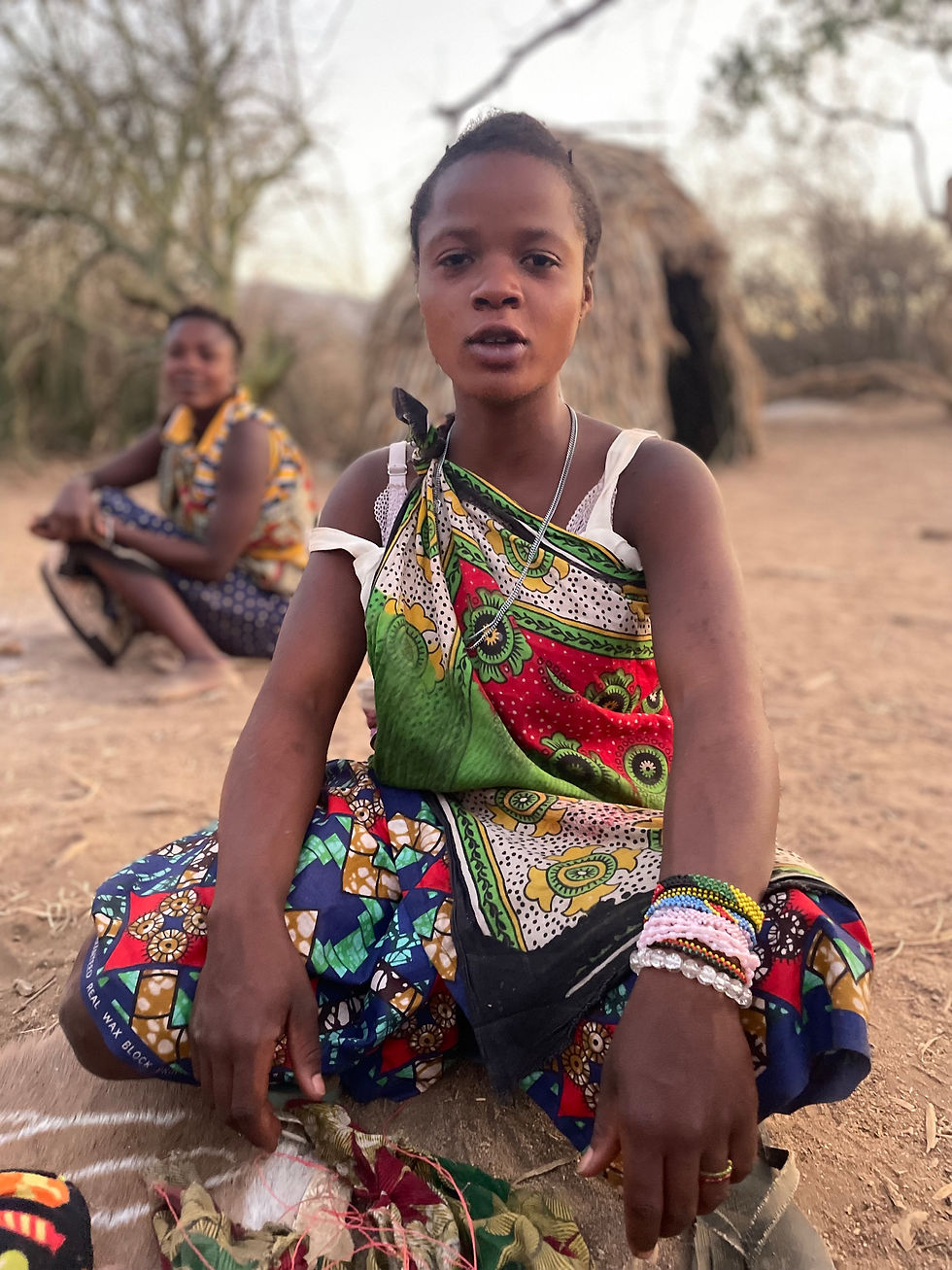
Ishoko, Haine and the Sky in Hadzabe Cosmology
In Hadzabe cosmology, the sky plays an important role in how the world is understood. Haine is described as a divine figure, while the sun, Ishoko, and the moon, Seeta are part of the celestial forces that shape life. These are not distant abstract ideas but figures that appear in stories and oral traditions through which the Hadzabe understand the order of the world.
Through these narratives, the sun and moon are closely connected to the rhythms of daily life. People move with the light of Ishoko, the sun, as they hunt, gather, and travel across the landscape around Lake Eyasi, the homeland we explain further in Hadzabe Tribe Location: Where Do They Live in Tanzania?. The cycles of the moon also mark important moments in social and ritual life. In this way, celestial bodies are not simply objects in the sky. They belong to a wider cosmology that connects the sky, the land, animals, and human life.
Rather than existing as a separate system of doctrine, these beliefs are part of a lived understanding of the world. Through stories about Haine, Ishoko, and the moon, the Hadzabe express how life, nature, and unseen forces are connected within a shared cosmic order.

A Hadzabe Creation Story
Among the Hadzabe of northern Tanzania, stories about the beginning of the world have traditionally been shared around the fire. They are told slowly, with pauses for laughter, questions, and reflection. These stories are not just tales about a distant past. They help explain why the world is the way it is, why different beings live differently, and how humans came to live as they do.
One well known story centers on Haine, a powerful being sometimes understood as a creator or ancestral figure. In the beginning, the earliest people were not yet fully human in the way people are today. They were said to resemble the long, thin figures seen in ancient rock paintings across the region, almost stick like beings who could barely bend their bodies. Because they could not bend, they could not sit easily by the fire, cook food, or live in comfort.
According to the story, Haine helped change this. He made it possible for people to bend, sit by the fire, cook meat, and gather together. In this sense, the story describes a transformation from an earlier state of being into fully human life, shaped by warmth, food, and social closeness.
The story also explains why different peoples came to live in different ways. At one point, Haine sent some beings to gather food and others to fetch water. But those who went to the river forgot their task and stayed there playing in the water like baboons. Because they did not return, Haine separated the groups. Those who followed their task became the Hadzabe, while the others remained baboons.
Later, the story continues with the arrival of other kinds of people. Pastoralists and farmers were given cattle, seeds, and tools, allowing them to settle, herd animals, and grow crops. The Hadzabe, however, were given something different. They were to live in the bush, move with the seasons, and eat from the land itself through hunting, berries, tubers, honey, and baobab fruit. Honey in particular remains an important part of Hadzabe life, something we explore further in The Hadzabe Honey Hunters of Tanzania: Wild Honey, Culture, Diet & Honeyguide Bird Explained.
Like many creation stories around the world, this one does more than explain origins. It gives meaning to difference. It explains why humans, animals, and ways of life are not the same, and why each belongs to a wider order. For the Hadzabe, the story is not only about the beginning of time. It reflects a worldview in which humans, animals, and land remain deeply connected, and in which the hunter gatherer way of life is part of a much larger story about the origins of life itself.

Epeme Rituals in Hadzabe Spiritual Life
Another important part of Hadzabe spiritual life is epeme. It is not just one ritual but a whole system of practices connected to hunting, adulthood, and the balance of life in the camp. Anthropologists who have worked with the Hadza often describe epeme through three elements: epeme meat eating, epeme gatherings, and the epeme dance. Because hunting is so central to Hadzabe life more broadly, it also helps to understand the practical side of it, something we explore in our Hadzabe Hunting Guide: Techniques, Tools & Morning Hunt Duration.
One part of the tradition involves the eating of special portions of meat from large animals. These parts are reserved for initiated adult men, sometimes referred to as epeme men. The moment itself is surrounded by rules and privacy, and women, children, and uninitiated men do not take part in it. The meaning of this practice is closely tied to ideas of manhood, hunting skill, and the responsibilities of adult men within Hadza society.
These gender specific traditions are only one part of a much wider social system. To understand the position of women beyond ritual life, I explore gender roles, equality and the remarkable independence of Hadza women in Women in Hunter Gatherer Societies: Gender Roles, Equality and Independence Among the Hadzabe.
Another element consists of epeme gatherings, where initiated men meet in smaller groups. These moments are described as private, and much of what happens in them is not openly shared with the rest of the camp. What is clear, however, is that these gatherings relate to hunting, social harmony, and the well-being of the group.
The most visible expression of the ritual system is the epeme dance. This is the moment when the wider community becomes involved. Women gather together, singing and clapping rhythmically, while men enter the dancing space one at a time. The atmosphere is intense, emotional, and deeply social. In many ways, the dance brings the whole camp together.
The timing of the ritual also follows the rhythms of the sky. Epeme dances traditionally take place during the dark phase of the moon, when the night is at its blackest and the moon is not visible. In this way the ritual connects human life with the wider cosmology of the Hadzabe world, where hunting, night, the sky, and spiritual life are closely intertwined.

What Hadzabe Spiritual Life Reveals About Human History
When we look at Hadzabe spiritual life, we are not only observing the beliefs of one community in northern Tanzania. We are also looking at something much older. For most of human history, people lived as hunter gatherers, closely connected to land, animals, and the rhythms of nature. In this sense, Hadzabe cosmology offers a rare window into ways of understanding the world that may once have been common across much of humanity. The same is true of other parts of Hadzabe life, including food, subsistence, and daily movement, something we explore further in 5 Eye Opening Facts About the Hadza Diet And What Hunter Gatherers Can Teach Us.
In Hadzabe thought, the sky, the land, animals, and human life are not separate domains. They form part of a living landscape where meaning is created through relationships rather than through fixed doctrines or institutions. The presence of figures such as Haine, the importance of celestial cycles such as those of Ishoko and Seta, and ritual traditions like epeme all reflect this worldview.
Anthropologists often suggest that spiritual systems among hunter gatherers tend to emphasize balance rather than hierarchy. The goal is not domination over nature, but coexistence within it. Rituals, stories, and everyday practices help maintain this balance between people, animals, and the wider forces that shape life.
Seen in this way, Hadzabe spiritual life is not simply a cultural curiosity. It is a reminder that human ways of understanding the world have taken many different forms. By listening to these traditions, we gain a glimpse of the kinds of beliefs that may have guided human communities for tens of thousands of years, long before the emergence of large agricultural societies and organized religions.

Experiencing Hadzabe Culture Respectfully Today
For travelers, understanding Hadzabe spiritual life changes the way a visit is experienced. Without that deeper context, it is easy to notice only the visible surface: bows and arrows, honey gathering, fire making, or a way of life that seems strikingly different from our own. But once you begin to understand something of Hadzabe cosmology, ritual life, and relationship with the natural world, the encounter becomes far more meaningful.
It is also important to remember that no culture remains frozen in time. Like every society, Hadzabe life has changed and continues to change. For generations, the Hadzabe have lived alongside neighboring groups, while also being shaped by missionaries, colonial rule, and wider political and economic forces. Outside contact is therefore not new. What matters is the form it takes.
Not all tourism is respectful. Some encounters are shallow, extractive, and openly exploitative. People are brought in for rushed visits, filmed for entertainment, turned into social media or YouTube content, and treated as though their lives exist for someone else’s curiosity. Many of these situations are built on common stereotypes and misunderstandings about the Hadzabe, something we explore in more detail in our article on 4 Common Misconceptions About the Hadzabe Tribe in Tanzania (And the Reality). When encounters are reduced to spectacle, the result is not cultural exchange but exploitation.
At the same time, responsible tourism can be one of the most important ways to support the continuity of Hadzabe culture today. Their ancestral living area has become smaller, and access to traditional hunting grounds and good water sources is no longer what it once was. In this reality, respectful tourism can provide income in a way that still allows dignity, cultural knowledge, and connection to land to remain central. So the point is not simply that outsiders get to visit the Hadzabe. The point is that, when done well, the Hadzabe also benefit from the encounter in ways that are fair, meaningful, and sustainable.
That is why we do not believe in treating the Hadzabe as a quick day trip or a cultural performance. Encounters should be approached with time, context, humility, and care. Sustainable and responsible tourism is not only about protecting nature. It is also about protecting people from being turned into spectacle, caricature, or content. When approached respectfully, meeting the Hadzabe can become one of the most moving experiences a traveler has in Tanzania, not only because it offers a rare encounter with one of the world’s last hunter gatherer peoples, but because it opens a different way of thinking about nature, community, and what it means to live well.
At Visit Natives, we believe these encounters should feel human, thoughtful, and deeply respectful to everyone involved. If you would like to understand what a respectful Hadzabe visit can look like in practice, you can read more about our Hadza hunter near Lake Eyasi – traditional hunting lifestyle in Tanzania | The Hadzabe Experience.
Frequently Asked Questions About Hadzabe Beliefs
What do the Hadzabe believe?
The Hadzabe spiritual worldview combines cosmology, ritual life, and oral traditions that connect humans, animals, and the natural world.
Do the Hadzabe have a religion?
Anthropologists often describe Hadzabe belief systems as animistic or cosmological rather than institutional religions.
Who is Haine in Hadzabe belief?
Haine is described in oral traditions as a powerful being connected to creation stories and the ordering of life.
What is the epeme ritual?
Epeme is a central ritual institution among the Hadzabe involving meat rituals, gatherings of initiated men, and communal night dances.
Are the Hadzabe animists?
Anthropologists often describe Hadzabe beliefs as a form of animism. In this context, animism means that the world is understood as alive with relationships and meaning. Humans, animals, landscapes, and celestial forces are seen as connected within a shared living environment.
Do the Hadzabe pray?
Yes. Prayer can be part of Hadzabe ritual life, especially in connection with hunting success, healing, and the well being of the community. Some accounts describe initiated men praying for good hunting, harmony in the camp, and protection from illness.
Do the Hadzabe believe in ancestor spirits?
Hadzabe traditions emphasize a connection between past and present generations, although beliefs about ancestors are not organized into a formal ancestor cult. Instead, the presence of earlier generations is understood as part of a broader spiritual relationship between the living, the dead, and the natural world.

About the Author
This article was written by Anniina Sandberg, an anthropologist and the founder of Visit Natives, a travel company focused on respectful cultural encounters with Indigenous and traditional communities around the world.
Anniina holds a Master’s degree in African Research and has spent many years studying and working in East Africa. Through her academic background and long-term field experience in Tanzania, she has developed a deep interest in hunter-gatherer societies, cultural traditions, and the ways different communities understand their relationship with nature.
Through Visit Natives, Anniina works to create travel experiences that are based on respect, cultural understanding, and responsible tourism. Rather than treating communities as attractions, her goal is to create encounters where travelers can learn directly from local people while ensuring that the benefits of tourism are shared fairly and sustainably.
Much of her work focuses on telling the stories behind the cultures travelers encounter like the beliefs, traditions, and worldviews that often remain invisible during ordinary tourism. This article is part of that broader effort to bring deeper anthropological context to places and people that are too often misunderstood.


